Stock Trends Mid-Quarter Review: How the Year-End 2025 Themes Are Performing in Q1 2026

Halfway through Q1 2026, the question is no longer theoretical: Did the year-end institutional momentum and ST-IM Alpha themes actually guide investors effectively?

With the updated February 13, 2026 Stock Trends dataset now in hand, we can measure the outcome directly — not against headlines, but against trend structure, relative strength, and momentum persistence.

The short answer: the framework largely held — but leadership rotated exactly where the model suggested it might.

Read more...

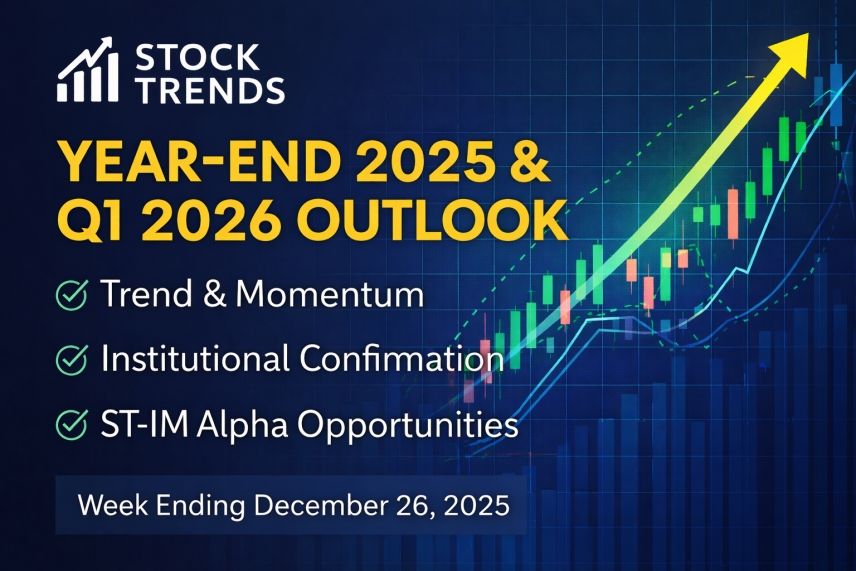
Stock Trends Year-End Analysis: Institutional Momentum, ST-IM Alpha, and the Road Into Q1 2026

As 2025 comes to a close, investors naturally ask whether the strongest trends visible at year-end represent durable opportunity—or merely seasonal noise. The Stock Trends framework addresses this question not by forecasting headlines, but by examining how trend structure, momentum and participation, and ST-IM forward opportunity align across different classes of capital.

This year-end outlook integrates three complementary lenses that Stock Trends users can carry directly into Q1 2026:

  • Large-cap institutional momentum — where capital can deploy at scale
  • Top Trending momentum leadership — where price discovery is happening fastest
  • Stock Trends Inference Model (ST-IM) — where forward return expectations and risk dispersion suggest true alpha opportunity
Read more...

Understanding Our Assumptions — A Decade Later

For decades, the Stock Trends framework has rested on a foundational analytical question: Can we infer future return tendencies from recurring patterns of trend, momentum, and trading activity?

In 2014, we formalized this question through the Stock Trends Inference Model (ST-IM), built on two basic premises:

  • Market conditions are non-specific to a particular security.
  • Market responses to these conditions are specific.

Those ideas remain central to Stock Trends today. But the investing world has changed. Academic research into momentum, trend-following, and behavioural finance has deepened; markets have experienced extreme macro cycles; and our own analytical tools have evolved dramatically.

A decade later, it is time to revisit the original assumptions, test them against modern evidence, and expand their meaning for today’s Stock Trends users.

Read more...

Trading Nvidia with the Stock Trends RSI +/– Pattern Analysis Model

Nvidia’s extraordinary rise in recent years has made it a centrepiece of both long-term institutional portfolios and short-term trading desks. Yet few tools provide a disciplined, data-driven lens for navigating NVDA’s volatile weekly momentum. The Stock Trends RSI +/– Pattern Analysis model model is one of them—an evidence-based framework that converts historical price–benchmark relationships into probabilistic expectations of next-week performance. When applied to NVDA-Q, it becomes a powerful guide for traders seeking tactical entries, binary-style short-term trades, or precision timing for longer-term positions.

Read more...

Navigating Market Turmoil in December 2025 – How Stock Trends Guides Investors

December 2025 arrives under a cloud of uncertainty: a K‑shaped slowdown following a prolonged U.S. government shutdown, diverging consumer fortunes, and fading AI euphoria have set the stage for markets riddled with volatility. Central banks are on pause, oil faces looming oversupply, and investors are questioning whether the tech boom can sustain its lofty valuations. Against this backdrop, Stock Trends’ data‑driven framework offers a beacon, spotlighting where defensive strength and innovation can outshine the turmoil—and where caution is warranted in the weeks ahead.

Read more...

When the “Big Short” Turned Its Eye on Tech: Interpreting the Burry Shock Through Stock Trends Indicators

When the news broke that famed investor Michael Burry—whose 2008 “Big Short” foresight became legend—had placed large put options against Nvidia (NVDA) and Palantir (PLTR), the market reacted with a collective shudder. Within hours of the disclosure, technology shares that had led the 2025 rally wavered. Headlines proclaimed the “AI bubble” had met its doubter, and retail investors who had crowded into the artificial-intelligence narrative rushed to reassess. The initial pullback in high-beta technology stocks was swift, but not indiscriminate. Beneath the surface, the Stock Trends Weekly Reporter data from October 31 to November 7 revealed a precise rotation in trend strength—one that Stock Trends subscribers could see developing before it hit the newswires.


Read more...

Using the Stock Trends Reports in Market Corrections

Sharp market selloffs are stressful… and useful. They create a live-fire laboratory where leadership quality is revealed in real time. In the Stock Trends framework, the most informative sequence is a stock that registers a New Weak Bullish (ST WeakBullishSmall) during the shock — a pullback statement in a bullish primary trend — and then, within a week, flips back to a Return to Strong Bullish (ST BullishSmall). That transition is a powerful confirmation that buyers remain in control.

Read more...

Stock Trends Select Bullish Crossover Portfolio

The Select Bullish Crossover Portfolio strategy stands at the intersection of systematic inference and market timing. Each position is chosen from the Stock Trends Inference Model’s Select list—names whose probability of outperforming the base random return is favorable across 4, 13, and 40 weeks. From this foundation, the portfolio then isolates Bullish Crossover (ST BullishXoverSmall) signals, capturing securities that have transitioned from neutral or bearish states into confirmed upward momentum. In this editorial, we look at the NYSE Select Bullish Crossover Portfolio's current holdings and discover that some themes are revealed.


Read more...

From Banks to Bytes to Uranium: Strong Bulls Align with ST-IM Signals

On September 17, 2025, the U.S. Federal Reserve delivered its first interest rate cut in nine months, lowering the federal funds rate by 25 basis points to a new target range of 4.00%–4.25%. This was a response to clear signs of a cooling labor market—slower job growth, shorter workweeks, and rising unemployment in several cohorts. Although inflation remains above the Fed’s 2% target, policymakers signaled that two more cuts are likely before the year’s end. This changing policy environment directly influences the Stock Trends signals observed in the week ending September 19.

Read more...

Stock Trends: The Human Side of Market Trends

Markets don’t move on math alone—they move on people. The screens light up because millions of humans react to news, stories, and each other. Behavioral economics is the field that studies those reactions. This article introduces the big ideas, then brings the story up to date with automated bots and AI trading—and explains how the Stock Trends framework helps you navigate it all.

Read more...
Subscribe to this RSS feed

Stock Trends Editorial

  • Leadership Beneath the Surface: How Stock Trends Identifies System-Critical Equities
    Leadership Beneath the Surface: How Stock Trends Identifies System-Critical Equities The broad market still reads as a rotation market rather than a generalized expansion phase. Energy, Materials, and Utilities remain the clearest sector-level leadership blocs, but the current Stock Trends dataset shows that a second layer of leadership is now becoming more visible beneath the sector averages. That secondary leadership is important because it does not present itself as broad participation. It appears instead through specific industry groups whose internal trend structure is materially stronger than that of their parent sectors. In this week’s data, the clearest examples are Semiconductors and Equipment, Telecommunications, Containers & Packaging, and Banking.
    29 March 2026 Read more...
  • Indexing Is the Baseline—Probability Is the Edge
    Indexing Is the Baseline—Probability Is the Edge The case for indexing continues to strengthen, and rightly so. The evidence is overwhelming: most active managers fail to outperform their benchmarks over time, and the costs of attempting to do so only compound the underperformance. For many investors, indexing has become not just a strategy, but the default solution. But the conclusion that often follows—that markets cannot be meaningfully outperformed—is where the interpretation begins to break down. The failure of traditional active management is not evidence that opportunity does not exist. It is evidence that non-probabilistic selection fails.
    24 March 2026 Read more...
  • Continuation, Not Expansion: What the Probability Structure Now Reveals
    Continuation, Not Expansion: What the Probability Structure Now Reveals The current market is not offering investors the kind of broad speculative expansion that often defines the early phase of a powerful advance. Nor is it confirming a simple risk-off breakdown. The latest Stock Trends dataset points to something more disciplined. The probability structure remains constructive, but it is now being expressed primarily through continuation and consolidation rather than broad breakout expansion.
    21 March 2026 Read more...
  • When Headlines Darken but the Probability Structure Holds
    When Headlines Darken but the Probability Structure Holds The recent Stock Trends editorials argued that hard assets had become structural leaders and that capital was rotating across themes rather than collapsing into a simple risk-on or risk-off binary. This week’s data adds a new layer. The market’s probability structure has improved even as the macro headlines have become more hostile. That is a distinct signal, and it is coming directly from the Stock Trends Inference Model.
    14 March 2026 Read more...
View all Stock Trends Editorials


Subscription Plans

STWR - Monthly

$19.95/Month

Monthly subscription plan to Stock Trends Weekly Reporter - pay your monthly subscription fees by having them automatically charged (PayPal only). Free 7-day trial period. Subscribers may cancel before the end of any subscription month.

STWR - 1 Year Prepaid Subscription

$199/Year

1 Year Prepaid subscription to Stock Trends Weekly Reporter. Save 16% off monthly rate!

STWR - 2 Year Prepaid Subscription

$299/2 Years

2 Year Prepaid subscription to Stock Trends Weekly Reporter. Save 37% off monthly rate!

STWR - 3 Year Prepaid Subscription

$399/3 Years

3 Year Prepaid subscription to Stock Trends Weekly Reporter. Save 44% off monthly rate!