Improving signs for the stock market

  • 22 January 2012 |
  • Written by  Skot Kortje, Stock Trends Analyst
  • font size
  • Print

Expectations of market volatility have dropped. The Volatility Index is Stock Trends Bearish; the S&P 500 index is about to turn Stock Trends Bullish. Is this a good time to be in equities?

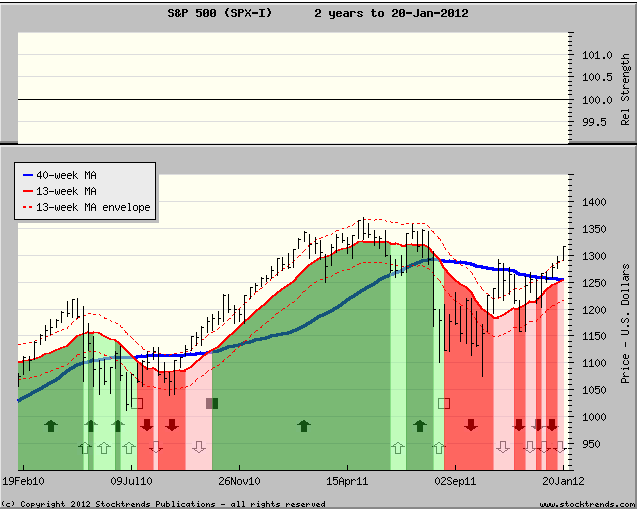
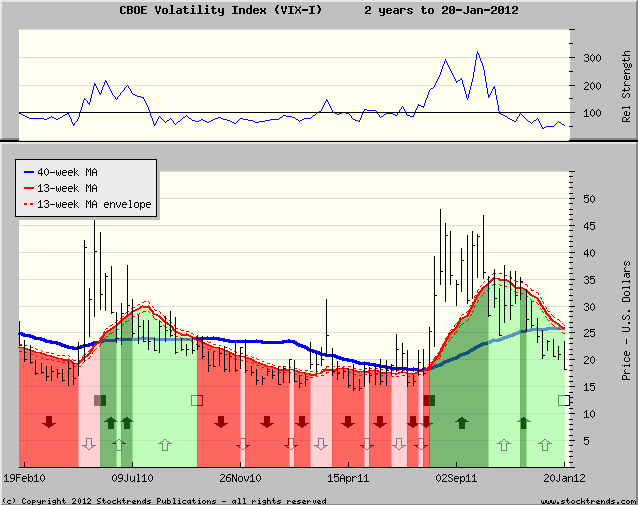
January’s market advance has offered a fresh hope for equity investors. The S&P 500 is up almost 5% in 2012, while the S&P/TSX Composite has advanced 4%. Another sign that perhaps signals a launch for markets ahead is shrinking market volatility. The CBOE Volatility Index (VIX) has dropped steadily from its peak in the autumn last year, and is now a Stock Trends Bearish Crossover . With the S&P 500 index now verging on a Bullish Crossover , this inverse relationship between market advances and dropping price volatility expectations may be a supporting signal of continued bullish trending for stocks.

The VIX measures the implied volatility of a range of S&P 500 options over the approaching 30 days, and is broadly used as an indicator of the market’s expectation of price volatility over the next month. This index is more accurately understood as an oscillator, with a mathematical expectancy of ‘mean reversion’. That is, although the index will fluctuate between ‘high’ or ‘low’ readings, it will revert to its mean, or average, level once it has peaked or troughed. This mean reversion reflects the market’s long-term expectations of volatility. Even in extremely volatile moments of market crisis, time and information tend to deflate investor anxiety; even in the calmest moments of complacency, the future invariably delivers market crisis. This is one of the truths of the investment world. It is a truth in life, too.
 

Inverse correlation of trend between the CBOE Volatility Index (VIX) and S&P 500 Index


Now that the VIX has returned to its mean level, how meaningful is its current Bearish Crossover indicator? If we look at the record of the past 16 years, the market has showed intermittent correlation with VIX Bearish Crossovers. The table below shows the performance of the S&P 500 index after the VIX turns Stock Trends Bearish with a Bearish Crossover  until it returns to a Stock Trends Bullish trend as a Bullish Crossover .
 
Of the 13 previous VIX Bearish Crossovers during the period - which would represent times when the intermediate trend (13-week average) of the Volatility index had returned back to its long-term average level (40-week average) – three VIX Bearish Crossovers were followed by significant positive returns for the S&P 500 index. Although the VIX Bearish Crossover signal was also followed by three significant drops in the S&P 500, in one of those occasions (June 15, 2001, prior to 9/11) the VIX Bearish Crossover was matched with an established Bearish trend for the S&P 500. The other occasions, January 4, 2002 and May 16, 2008, preceded major market collapses.
 
Overall, the inverse correlation of the VIX Bearish Crossover  as a market-timing indicator appears substantiated when the matching S&P 500 trend is either Bullish or Weak Bearish - as it is now. The current market conditions – supremely affected by the far-from-resolved Euro crisis and the U.S. election cycle – suggest that this recent lull in market anxiety will be positive for equities. The VIX tells us now is the time to be in stocks again.


Performance of the S&P 500 index

during a VIX Stock Trends Bearish trend

Date

VIX

ST Trend

VIX

Price

S&P 500

ST Trend

S&P 500

Price

 S&P 500

% Chg

10/11/96 15.51 700.66  
12/13/96 22.26 728.64 4%
2/20/98 19.55 1034.21  
8/21/98 31.91 1081.18 5%
1/08/99 23.88 1275.09  
2/18/00 28.45 1346.09 6%
8/04/00 21.54 1462.93  
11/24/00 29.58 1341.77 -8%
6/15/01 26.33 1214.36  
9/28/01 35.19 1040.94 -14%
1/04/02 22.02 1172.51  
7/12/02 38.33 921.39 -21%
1/10/03 27.13 927.57  
5/13/05 16.32 1154.05 24%
7/15/05 10.33 1227.92  
10/21/05 16.13 1179.59 -4%
12/02/05 11.01 1265.08  
5/26/06 14.26 1280.16 1%
10/13/06 10.75 1365.62  
3/30/07 14.64 1420.86 4%
5/16/08 16.47 1425.35  
9/19/08 32.07 1255.08 -12%
4/17/09 33.94 869.6  
5/28/10 32.07 1089.41 25%
10/01/10 22.5 1146.24  
7/29/11 25.25 1292.28 13%
1/20/12 18.28 1315.38  
 
back to top

Subscriber Testimonials

  • I have had the good fortune to be reasonably successful and enjoy the investment process. Your process would be recommended for both experts and those who are new to investing.

    Frank I., Subscriber
  • Hence, anyone who had followed the "Stock Trends" line should have sold their Bre-X shares and, with the windfall, paid for a lifetime subscription to The Globe and Mail and more. Talk about return on investment!

    Muni P., Subscriber

  • Thank you for your excellent work and kind approach to your customers.

    Odette C., Subscriber

  • I find your website and research very helpful in my stock trading. I have subscribed to several related services in the past and none present their work with “just the facts” as you. Please keep up the great work so that I can continue to learn! 

    Bryan E., Subscriber
  • I am fascinated with your service and methodology - it is very impressive. [...] Over the years I have concluded that there are many ways to approach stock investing, but once one has chosen a path, one is better off sticking to it.



    Bob E., Subscriber

  • I use Stock Trends to help direct my stock picks. Also, following the advice of Stock Trends I have religiously used stop-loss orders and have avoided hanging on to losing stocks for emotional reasons.

    John B., Subscriber
  • Stock Trends analysis quantifies nicely the movement of individual stocks. I’ve found that if the technicals are out of synch with fundamental analysis, it is a wake-up call to make a decision. The Stock Trends Bull/Bear Ratio is useful in identifying major market bottoms and tops. It has always presented a good buying or selling opportunity.

    Charles G., Subscriber
  • I've followed your recommendations since reading your columns in the Globe & Mail, and finding they published Stock Trends arrows in their financial listings. I do find them a guide to the general market and what I should be avoiding for declining chart trends.
    Has probably saved me the subscription by not rushing into hot stocks!

    Anthony D., Subscriber
  • An admitted cynic, it's obviously very high praise when he says he likes StockTrends because of its "simplicity, utility, openness, [and] honesty," and in addition to having "no hidden agenda" is "understandably documented [and] historically verifiable." And, he adds, "It lets me see a lot of things without doing a lot of work." Globe and Mail

    Paul W., Subscriber

  • I want to thank you for posting such an excellent guide to technical analysis on the web. You have provided a great service to all of us novice investors.

    Michael C., Stock Trends user
  • Stock Trends information is part of the base information I review before making a trade.

    Subscriber
  • Stock Trends Weekly Reporter is an easy way to pick up equities that represent an upward trend.

    Subscriber
  • I've followed a number of Stock Trends picks, and the methodology is solid.

    Doug B., Subscriber

  • I am just writing to tell you of my appreciation of your service! It makes so much sense to me. You seem to be an oasis of stability and sensibility in a stockmarket jungle.

    Adrian S., Subscriber

  • Your report is an impressive, excellent tool and I have recommmended it to friends.

    Colin E., Subscriber

  • There is a lot to be gained from comparing trends of how individual stocks are doing within a sector, as well as how the sector is performing relative to the broad market.

    Dudley R., Subscriber

  • You have created and maintained an amazing, highly educational program and I am grateful for your part in getting our retirement funds to the good place they are.

    Karin M., Subscriber
  • I am something of a momentum investor. I find Stock Trends useful as I can look at my portfolio as a “watch list” and quickly see where trends are declining in strength or reversing, so it is particularly useful as a tool in portfolio management regarding sales.

    William C., Subscriber
  • Just thought I'd call to thank you, Skot. Stock Trends Weekly Reporter helped pay for my daughter's education!

    Peter H., Subscriber

  • I very much like the systematic approach to analyzing stock data, it fits my approach.

    Subscriber

Subscription Plans

Subscription Plans

STWR - Monthly

$19.95

Monthly subscription plan to Stock Trends Weekly Reporter - pay your monthly subscription fees by having them automatically charged (PayPal only). Free 7-day trial period. Subscribers may cancel before the end of any subscription month.

STWR - 1 Year Prepaid Subscription

$199.00

1 Year Prepaid subscription to Stock Trends Weekly Reporter. Save 16% off monthly rate!

STWR - 2 Year Prepaid Subscription

$299.00

2 Year Prepaid subscription to Stock Trends Weekly Reporter. Save 37% off monthly rate!

STWR - 3 Year Prepaid Subscription

$399.00

3 Year Prepaid subscription to Stock Trends Weekly Reporter. Save 44% off monthly rate!

Stock Trends Editorial

  • When Headlines Darken but the Probability Structure Holds
    When Headlines Darken but the Probability Structure Holds The recent Stock Trends editorials argued that hard assets had become structural leaders and that capital was rotating across themes rather than collapsing into a simple risk-on or risk-off binary. This week’s data adds a new layer. The market’s probability structure has improved even as the macro headlines have become more hostile. That is a distinct signal, and it is coming directly from the Stock Trends Inference Model.
    14 March 2026 Read more...
  • War, Inflation, and Rotation: What Stock Trends Reveals After the Middle East Shock
    War, Inflation, and Rotation: What Stock Trends Reveals After the Middle East Shock This week's market headlines have been dominated by war, oil, and inflation fears. However, the Stock Trends context indicates that this is not a broad liquidation. It is a disciplined rotation into sectors tied to scarcity, resilience, and security. Markets do not move from a blank slate. They rotate, they re-price, and they reveal where capital was already preparing to move before the headlines become obvious. This past week’s escalation in the Middle East has undeniably shaken investor confidence, but the latest Stock Trends dataset suggests that the deeper message is not indiscriminate panic. It is a reordering of leadership.
    07 March 2026 Read more...
  • Not Risk-On. Not Risk-Off. Rotation.
    Not Risk-On. Not Risk-Off. Rotation. Not Risk-On. Not Risk-Off. Rotation. In our recent editorial, The Hard Asset Regime Is Not a Trade — It’s a Structure, we examined the persistent leadership emerging in gold and materials and argued that real assets were no longer functioning as short-term hedges, but as structural participants in the market. The current Stock Trends dataset extends that thesis — but in a different direction. The 13-week ST-IM probability model is no longer pointing to a narrow leadership cluster. It is identifying a market redistributing capital across multiple durable themes simultaneously. This is not a simple “risk-on” environment. It is not a defensive “risk-off” retreat. It is rotation.
    02 March 2026 Read more...
  • The Hard-Asset Regime Is Not a Trade — It’s a Structure
    The Hard-Asset Regime Is Not a Trade — It’s a Structure Markets rarely move randomly. They rotate. They reallocate. They transition from one leadership regime to another. And when that transition is real, it shows up not in headlines — but in breadth. This week’s Stock Trends universe reveals something decisive. When we measure common stocks only (removing ETFs that duplicate underlying holdings), two sectors stand apart: Materials and Energy.
    21 February 2026 Read more...
View all Stock Trends Editorials


Subscription Plans

STWR - Monthly

$19.95/Month

Monthly subscription plan to Stock Trends Weekly Reporter - pay your monthly subscription fees by having them automatically charged (PayPal only). Free 7-day trial period. Subscribers may cancel before the end of any subscription month.

STWR - 1 Year Prepaid Subscription

$199/Year

1 Year Prepaid subscription to Stock Trends Weekly Reporter. Save 16% off monthly rate!

STWR - 2 Year Prepaid Subscription

$299/2 Years

2 Year Prepaid subscription to Stock Trends Weekly Reporter. Save 37% off monthly rate!

STWR - 3 Year Prepaid Subscription

$399/3 Years

3 Year Prepaid subscription to Stock Trends Weekly Reporter. Save 44% off monthly rate!