Return expectations for Twitter $TWTR #notgood

  • 03 May 2015 |
  • Written by  Skot Kortje, Stock Trends Analyst
  • font size
  • Print

The Stock Trends Inference Model analysis of Twitter (TWTR) presents a discouraging intermediate-term outlook.

There’s a new social media button: UnLike. Twitter’s stock (TWTR) might be the first click. It’s tumble last week erased much of the first quarter goodwill the market had buffed up, closing at $37.84 on Friday and leaving behind the previous $50 support level in splinters. With any market response of this profile there are hails of panic, as well as resolve. Does an investor see this correction as the beginning of an even nastier fall or an opportunity to take advantage of nervous Nellies?


Technical analysis is, by definition, the study of price and trading activity. It seeks to answer the basic question posed in any market - Do I buy, or do I sell? - by interpreting past market action and prognosticating about future market action. Sometimes the market characteristics of a particular stock (or any trading instrument) are not that distinguishable or distinguishing. And then there are stocks with market activity that is much more categorically defined. Hello, Twitter!


Stock Trends allows us to isolate market characteristics - and especially so when there is a selloff. The 25.5% drop of TWTR last week flushed out many investors, and the usually high volume of trading indicator tells us the scope of this sentiment change is substantial. When we see a change to a Stock Trends Weak Bullish indicator () on this kind of price and volume move the technical aspects of the stock are quite distinguishable.
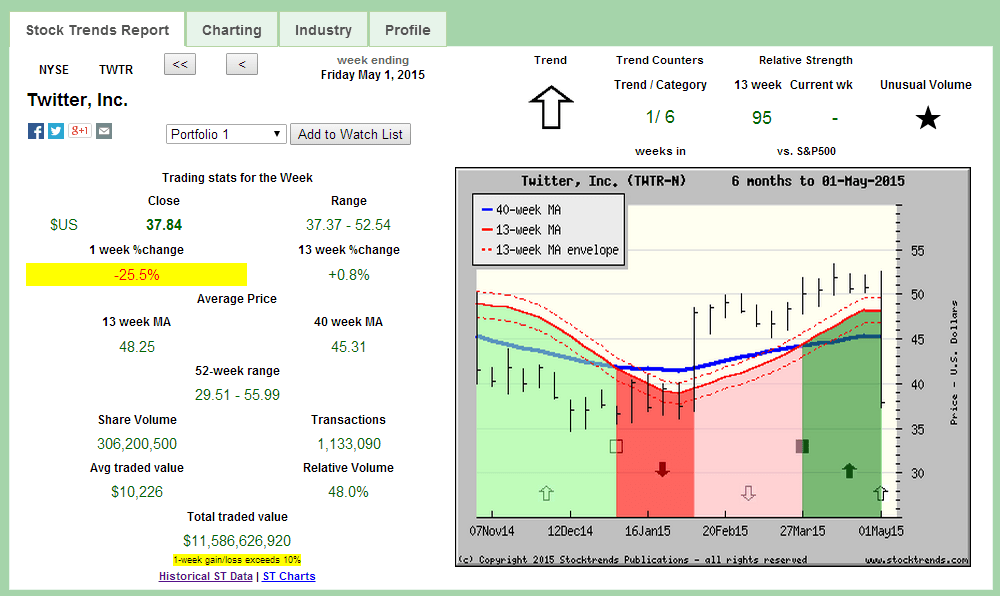


TWTR’s Stock Trends Report shows a combination of indicators that make this event categorically interesting: the trend indicator is Weak Bullish (), with a minor trend counter of 1, and a major trend counter now at 6, an RSI of 95 - , and an unusually high volume indicator (). The market characteristic described by this Stock Trends indicator combination is of a stock that is relatively early in a Bullish trend but has tripped rather suddenly on significant bad market news. While the drop in price was substantial last week, TWTR is still only underperforming the S&P 500 by 5% measured over the past 13-weeks.


The Stock Trends Inference Model (ST-IM) analysis is designed to make a statistical evaluation of market conditions - especially those market conditions that are most clearly defined. The Stock Trends Report on TWTR is now a good example. What does the ST-IM analysis say now about this stock’s future price expectations? Remember that the ST-IM analysis samples 30-years of Stock Trends data looking for stocks with similar indicator combinations, measuring post-observation statistics of 4-week, 13-week, and 40-week returns. From the samples we infer population parameters of these returns and estimate the probability of the current stock (here TWTR) bettering the estimated future returns of a randomly selected stock.


Here is the current ST-IM analysis of TWTR:
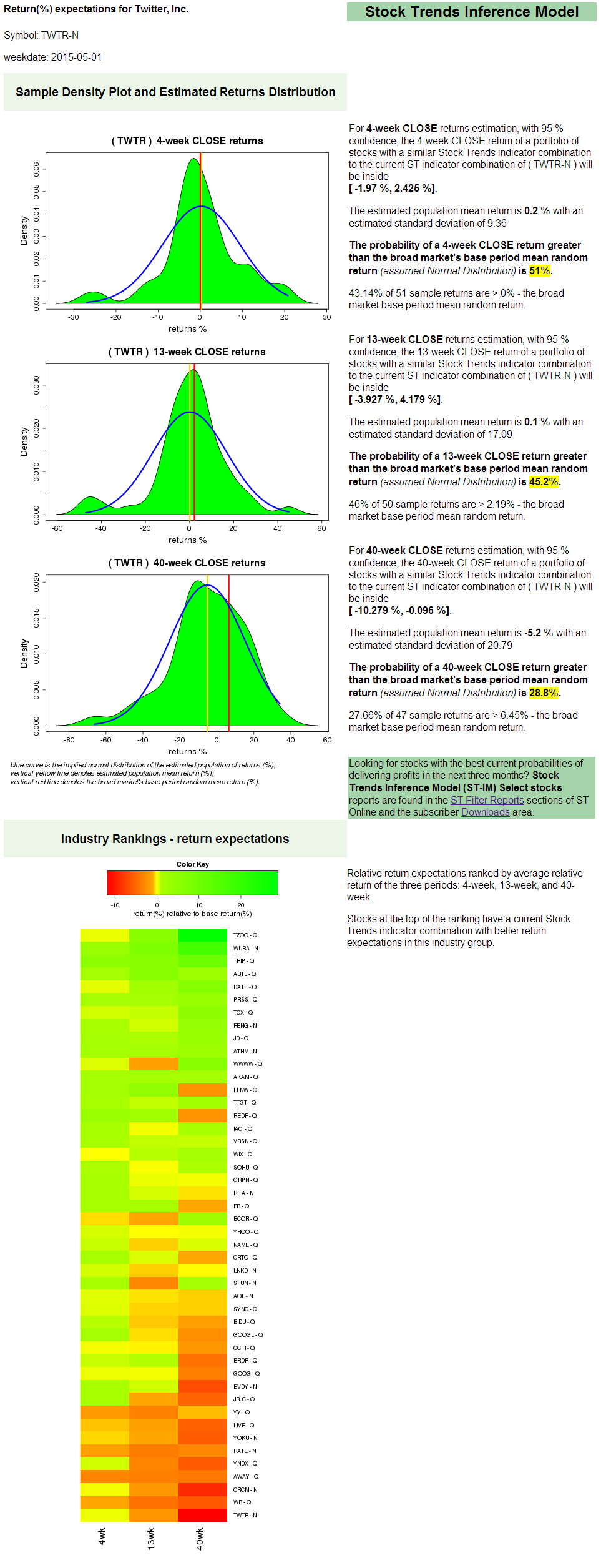
 
STIM - returns expectations for Twitter TWTR


What does this analysis tell us? First, we see that the short-term price expectations are relatively neutral, with the mean return expectations near the expected return of a randomly selected stock (0%). There is a 51% probability that the 4-week return of TWTR will be positive (greater than 0%, the expected return of a broad market randomly selected stock). Not much better than the 50% probability that you would see a positive 4-week return in a randomly selected stock.
 
However, the 13-week and 40-week expected returns of TWTR are much more concerning. The probability of TWTR having a 13-week return better than the expected 13-week return of a randomly selected stock (2.19%) is only 45.2%. Looking further out on the time horizon is even more bleak. The probability of TWTR having a 40-week return greater than the expected 40-week return of a randomly selected stock (6.45%) is just 28.8%. Remember, a randomly selected stock has a 50% probability of having a 40-week return greater than 6.45%.


The ST-IM analysis tell us that TWTR, as defined by the current Stock Trends indicator combination, has a significantly low probability of delivering positive returns over the intermediate time periods ahead.


back to top

Subscriber Testimonials

  • Stock Trends information is part of the base information I review before making a trade.


    Subscriber
  • I find your website and research very helpful in my stock trading. I have subscribed to several related services in the past and none present their work with “just the facts” as you. Please keep up the great work so that I can continue to learn! 

    Bryan E., Subscriber
  • I've followed your recommendations since reading your columns in the Globe & Mail, and finding they published Stock Trends arrows in their financial listings. I do find them a guide to the general market and what I should be avoiding for declining chart trends.
    Has probably saved me the subscription by not rushing into hot stocks!

    Anthony D., Subscriber
  • There is a lot to be gained from comparing trends of how individual stocks are doing within a sector, as well as how the sector is performing relative to the broad market.

    Dudley R., Subscriber

  • Thank you for your excellent work and kind approach to your customers.

    Odette C., Subscriber

  • I want to thank you for posting such an excellent guide to technical analysis on the web. You have provided a great service to all of us novice investors.

    Michael C., Stock Trends user
  • I've followed a number of Stock Trends picks, and the methodology is solid.

    Doug B., Subscriber

  • An admitted cynic, it's obviously very high praise when he says he likes StockTrends because of its "simplicity, utility, openness, [and] honesty," and in addition to having "no hidden agenda" is "understandably documented [and] historically verifiable." And, he adds, "It lets me see a lot of things without doing a lot of work." Globe and Mail

    Paul W., Subscriber

  • I use Stock Trends to help direct my stock picks. Also, following the advice of Stock Trends I have religiously used stop-loss orders and have avoided hanging on to losing stocks for emotional reasons.

    John B., Subscriber
  • I am something of a momentum investor. I find Stock Trends useful as I can look at my portfolio as a “watch list” and quickly see where trends are declining in strength or reversing, so it is particularly useful as a tool in portfolio management regarding sales.

    William C., Subscriber
  • Hence, anyone who had followed the "Stock Trends" line should have sold their Bre-X shares and, with the windfall, paid for a lifetime subscription to The Globe and Mail and more. Talk about return on investment!

    Muni P., Subscriber

  • Your report is an impressive, excellent tool and I have recommmended it to friends.

    Colin E., Subscriber

  • I very much like the systematic approach to analyzing stock data, it fits my approach.

    Subscriber
  • I have had the good fortune to be reasonably successful and enjoy the investment process. Your process would be recommended for both experts and those who are new to investing.

    Frank I., Subscriber
  • Stock Trends analysis quantifies nicely the movement of individual stocks. I’ve found that if the technicals are out of synch with fundamental analysis, it is a wake-up call to make a decision. The Stock Trends Bull/Bear Ratio is useful in identifying major market bottoms and tops. It has always presented a good buying or selling opportunity.

    Charles G., Subscriber
  • Stock Trends Weekly Reporter is an easy way to pick up equities that represent an upward trend.

    Subscriber
  • I am just writing to tell you of my appreciation of your service! It makes so much sense to me. You seem to be an oasis of stability and sensibility in a stockmarket jungle.

    Adrian S., Subscriber

  • Just thought I'd call to thank you, Skot. Stock Trends Weekly Reporter helped pay for my daughter's education!

    Peter H., Subscriber

  • I am fascinated with your service and methodology - it is very impressive. [...] Over the years I have concluded that there are many ways to approach stock investing, but once one has chosen a path, one is better off sticking to it.

    Bob E., Subscriber

  • You have created and maintained an amazing, highly educational program and I am grateful for your part in getting our retirement funds to the good place they are.

    Karin M., Subscriber

Subscription Plans

Subscription Plans

STWR - Monthly

$19.95

Monthly subscription plan to Stock Trends Weekly Reporter - pay your monthly subscription fees by having them automatically charged (PayPal only). Free 7-day trial period. Subscribers may cancel before the end of any subscription month.

STWR - 1 Year Prepaid Subscription

$199.00

1 Year Prepaid subscription to Stock Trends Weekly Reporter. Save 16% off monthly rate!

STWR - 2 Year Prepaid Subscription

$299.00

2 Year Prepaid subscription to Stock Trends Weekly Reporter. Save 37% off monthly rate!

STWR - 3 Year Prepaid Subscription

$399.00

3 Year Prepaid subscription to Stock Trends Weekly Reporter. Save 44% off monthly rate!

Stock Trends Editorial

  • Market Intelligence Begins With Context
    Market Intelligence Begins With Context A Bullish stock is not the same thing as a broadly Bullish market. A leading sector is not necessarily strengthening. A favorable historical return distribution is not a forecast. And a market environment that resembles a persistent Bullish structure can still contain weakening participation beneath the surface. Those distinctions are becoming increasingly important because investment research is no longer consumed only by people looking at charts and tables. The same evidence can now be queried by portfolio systems, software applications and AI agents capable of combining thousands of observations in seconds. That makes the quality of the underlying market intelligence more important, not less. Before a machine can reason about a market, the data must make clear what is being measured, which population it describes, when it was observed and what can legitimately be inferred from it.
    05 October 2026 Read more...
  • The Indexes Have Confirmed. The Market Beneath Them Has Not.
    The Indexes Have Confirmed. The Market Beneath Them Has Not. Five months ago, the Stock Trends data showed an unusual development. Favorable forward-return distributions were expanding beyond established Bullish trends and appearing in Weak Bullish, consolidation, and even selected Bearish configurations. The implication was that probability was improving before conventional trend confirmation. The September 18 dataset tells the next chapter of that story. Forward probability has not continued to disperse across trend states. It has moved back toward Bullish structures, particularly among broad-market ETFs. Yet the common-stock universe beneath those indexes has barely become more bullish at all.
    19 September 2026 Read more...
  • Forward Probability Is Expanding Beyond Trend Confirmation
    Forward Probability Is Expanding Beyond Trend Confirmation The recent Stock Trends editorials have established that the current market is not defined by a unified directional regime. Instead, it is characterized by internal dispersion, where leadership is fragmented across sectors, industries, and individual securities. The latest dataset reinforces that conclusion. But more importantly, it reveals a structural shift beneath the surface: forward return probabilities are no longer tightly coupled to traditional trend classifications.
    08 April 2026 Read more...
  • Leadership Beneath the Surface: How Stock Trends Identifies System-Critical Equities
    Leadership Beneath the Surface: How Stock Trends Identifies System-Critical Equities The broad market still reads as a rotation market rather than a generalized expansion phase. Energy, Materials, and Utilities remain the clearest sector-level leadership blocs, but the current Stock Trends dataset shows that a second layer of leadership is now becoming more visible beneath the sector averages. That secondary leadership is important because it does not present itself as broad participation. It appears instead through specific industry groups whose internal trend structure is materially stronger than that of their parent sectors. In this week’s data, the clearest examples are Semiconductors and Equipment, Telecommunications, Containers & Packaging, and Banking.
    29 March 2026 Read more...
View all Stock Trends Editorials


Subscription Plans

STWR - Monthly

$19.95/Month

Monthly subscription plan to Stock Trends Weekly Reporter - pay your monthly subscription fees by having them automatically charged (PayPal only). Free 7-day trial period. Subscribers may cancel before the end of any subscription month.

STWR - 1 Year Prepaid Subscription

$199/Year

1 Year Prepaid subscription to Stock Trends Weekly Reporter. Save 16% off monthly rate!

STWR - 2 Year Prepaid Subscription

$299/2 Years

2 Year Prepaid subscription to Stock Trends Weekly Reporter. Save 37% off monthly rate!

STWR - 3 Year Prepaid Subscription

$399/3 Years

3 Year Prepaid subscription to Stock Trends Weekly Reporter. Save 44% off monthly rate!