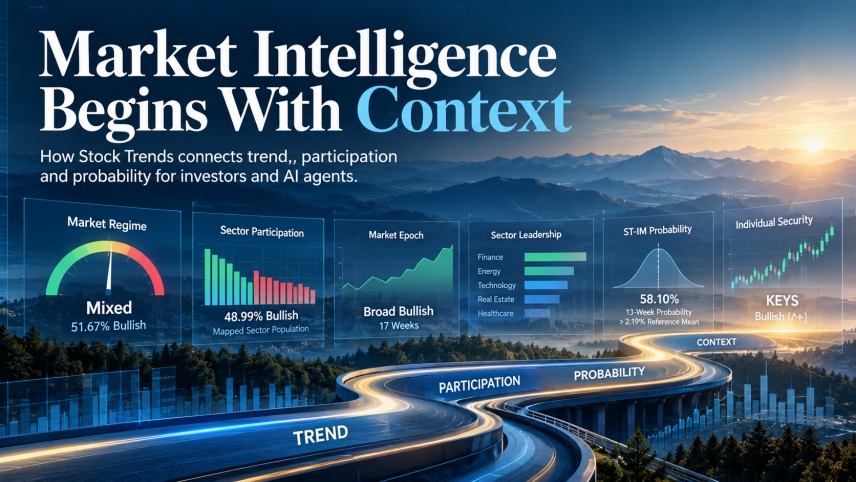
A Bullish stock is not the same thing as a broadly Bullish market. A leading sector is not necessarily strengthening. A favorable historical return distribution is not a forecast. And a market environment that resembles a persistent Bullish structure can still contain weakening participation beneath the surface.
Those distinctions are becoming increasingly important because investment research is no longer consumed only by people looking at charts and tables. The same evidence can now be queried by portfolio systems, software applications and AI agents capable of combining thousands of observations in seconds.
That makes the quality of the underlying market intelligence more important, not less. Before a machine can reason about a market, the data must make clear what is being measured, which population it describes, when it was observed and what can legitimately be inferred from it.
 I am something of a momentum investor. I find Stock Trends useful as I can look at my portfolio as a “watch list” and quickly see where trends are declining in strength or reversing, so it is particularly useful as a tool in portfolio management regarding sales.